


-
Call Us
+8619906035385 -
Email us
ping@aotbattery.com
Call Us
+8619906035385Email us
ping@aotbattery.com
1. What is a Battery Stacking Machine
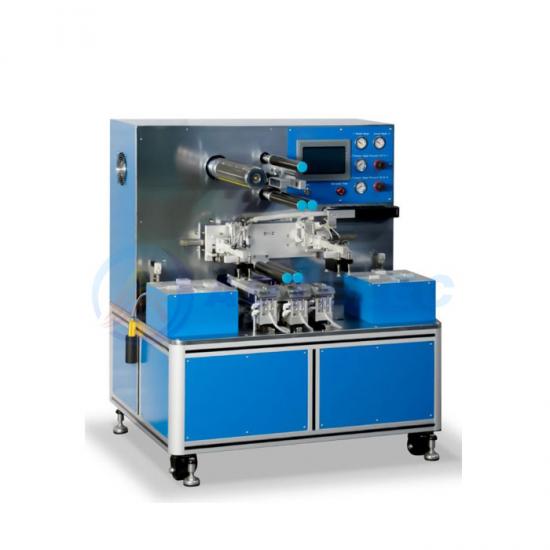
The battery stacking machine belongs to the specialized automatic equipment for the pre-processing of lithium batteries, specifically for the formation of the electrode core. It differs from the traditional winding machine that winds the battery cells. It follows the alternating arrangement process of "negative electrode - separator - positive electrode - separator", automatically cutting, transferring, laminating the electrode sheets and separators, and finally pressing and shaping regular square, pouch, and blade-type lithium battery cells. It is divided into three categories: semi-automatic, horizontal fully automatic, and vertical Z-type fully automatic. It is an indispensable core equipment for power lithium battery, energy storage lithium battery, and digital lithium battery production lines.
2. The Core Function of the Battery Lamination Machine
(1) Process Forming Function: It replaces manual stacking and traditional winding processes, completing the standardized lamination and formation of the battery cell electrode core. The laminated battery cell has lower internal resistance and more stable discharge, and is suitable for the requirements of high-power batteries.
(2) Quality improvement and cost reduction effect: Avoiding errors in manual stacking and damage to the separators, increasing the yield of battery cells, reducing the loss of raw materials for electrode sheets and separators, and significantly lowering the labor costs of the factory production.
(3) Adaptation for mass production: It is capable of adapting to the flexible production of various specifications of battery cells, and can be connected to cleanrooms and intelligent MES production lines, meeting the standardized mass production and compliance inspection requirements of automakers and energy storage manufacturers.
(4) Optimizing battery performance: The laminated cell structure ensures uniform force distribution, resulting in a lower bulging rate during charging and discharging, longer cycle life, and better suitability for high-load usage scenarios such as outdoor energy storage and vehicle-mounted bumpy conditions.
3. Comparative analysis of mainstream stacking machines in the market
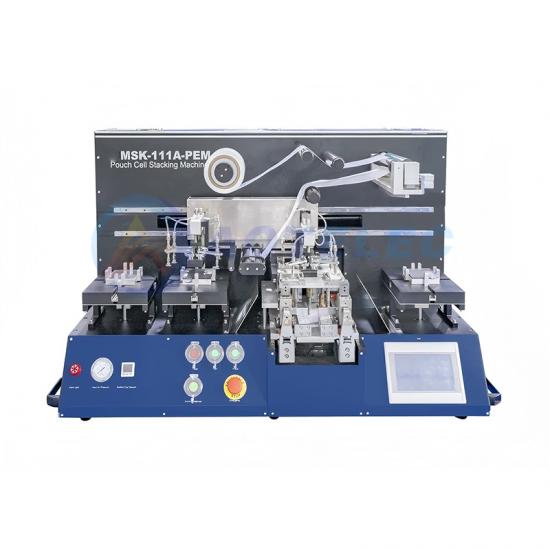
(1) Semi-automatic manual stacking machine vs. fully automatic laminating machine: The purchase cost of the semi-automatic model is 30% lower, but it requires manual film placement, deviation correction, and material extraction throughout the process. The hourly production capacity is only 450 battery cells. Human error can lead to a laminating deviation of ±0.1mm, making it suitable only for small workshops for sample trial production; Our factory's fully automatic laminating machine operates without human intervention throughout the process. It is equipped with a visual closed-loop deviation correction system, maintaining constant laminating accuracy. It can be connected to the MES factory intelligent system and is compatible with environmental impact assessment and automotive OEM secondary supplier qualification audits. Long-term labor costs can be saved by 60%.
(2) Traditional horizontal laminating machine vs. Vertical Z-type laminating machine: The traditional horizontal stacking machine has an outdated structure, resulting in uneven tension during the lamination process. During high-temperature mass production, the membranes are prone to rupture, and it is only suitable for a single type of battery cell specification. The vertical Z-type stacking machine is our upgraded model. It features a flexible tension control structure and can be compatible with various types of battery cells such as square, pouch, and blade. It operates smoothly in both high-temperature and low-temperature workshops, with a 75% reduction in equipment failure rate compared to the previous model, and the maintenance cycle has been doubled.
(3) Key points for identifying high-quality laminating machine suppliers: Low-end manufacturers only assemble the entire machine and do not have their own self-developed visual correction programs. The accuracy of the equipment significantly decreases after 3 months of operation. High-quality suppliers have the ability to adjust the tension of the foil and customize the overall machine operation conditions. Before leaving the factory, they must conduct 72-hour high-low temperature linkage tests and can provide complete services including overseas machine certification, production line connection drawings, and on-site installation and commissioning.
4. Common Issues Analysis
Q1: Why do cells produced by stacking machines tend to have foil offset? In most cases, it is not a problem with the raw materials. Low-end equipment lacks a dual vision real-time correction module. Vibrations in the workshop and fluctuations in temperature and humidity will cause offset; our factory equipment is equipped with two cameras on the top and bottom for real-time calibration, which eliminates interference from the workshop environment and prevents foil offset from occurring at the hardware level.
Q2: Can the new and old production lines be compatible and connected to the new laminating machine? Support for non-standard modifications, capable of adapting to the old production lines that have been transformed from winding to laminating, as well as the equipment of domestic or imported previous and subsequent processes for equipment linkage. Engineers can conduct on-site measurement of the production line dimensions and customize the connection transmission structure. There is no need to renovate the original cleanroom infrastructure.
Q3: What are the easily worn-out components of the stacking machine that require frequent replacement? Is the maintenance cost high? The only common wearables are the diaphragm press roller and the positioning suction cup. Our factory offers general spare parts in global stock and direct delivery. Compared to imported laminating machines, the annual maintenance cost is reduced by 45%, and the whole machine is guaranteed for 2 years, while the core electronic control components are guaranteed for 5 years.
Q4: Will the low-temperature workshop affect the operating accuracy of the laminating machine? For conventional low-end equipment, the accuracy will be lost when the environment is below 10℃. Our factory's model is equipped with a constant-temperature control cabinet, and it can operate stably within the entire range of -5℃ to 50℃ in the workshop. It is suitable for large-scale production in northern factories and cold regions overseas factories.

Tel/Whatsapp: +8619906035385

Friend link :
AOT BATTERY IPv6 network supported
Scan to wechat: