


-
Call Us
+8619906035385 -
Email us
ping@aotbattery.com
Call Us
+8619906035385Email us
ping@aotbattery.com
1.What is a battery powder press machine?
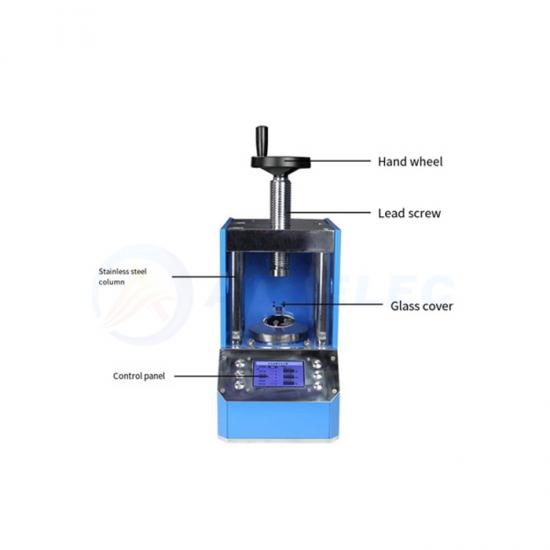
A battery powder press machine is an essential core forming equipment in the research, development, and production of new energy batteries. Simply put, it is an industrial device that uses precisely controlled pressure to compress battery powder materials—such as cathode, anode, and solid electrolyte—into electrode sheets or green compacts with specific shapes, thicknesses, and densities within dedicated molds.
Unlike conventional powder metallurgy presses or tabletting machines, powder pressing machines used in the battery industry have three distinct characteristics: first, they require extremely high pressure accuracy, typically controlled within ±1% or even ±0.5%; second, they demand strict cleanliness standards, with no oil contamination, metal chips, or other impurities allowed to pollute battery materials; third, the compaction process involves complex profiles, often requiring segmented pressure application, multiple degassing steps, and gradient holding pressures to achieve uniformly performing electrode sheets.
2. What is the core function of a battery powder tablet press?
The battery powder tablet press serves as a "material performance converter" in the entire battery production line—it transforms loose powders into solid electrode sheets with defined electrochemical properties, making it one of the key processes determining the final quality of the battery. Its core functions are primarily reflected in the following four aspects:
(1) Enhancing battery energy density. The tap density of loose cathode powder typically ranges from 1.0 to 1.5 g/cm³, whereas after high-pressure compaction exceeding 200 MPa, the compacted density can reach 3.4–3.8 g/cm³. This means that the same volume of a cell can accommodate significantly more active material, directly increasing capacity by over twofold. In the current "energy density race" among power batteries, every 0.1 g/cm³ increase in compacted density corresponds to an energy density gain of 5–8 Wh/kg—this is precisely why major battery manufacturers are investing heavily, regardless of cost, in high-precision presses.
(2) Ensuring battery performance consistency. For batteries from the same batch, if the electrode thickness deviation exceeds 0.01 mm or density fluctuation exceeds 0.05 g/cm³, it will result in excessive capacity differences among individual cells, causing the overall usable capacity of the pack to be limited by the "weakest link" effect. A high-quality powder press can control the inter-sheet thickness tolerance within ±0.005 mm, achieving a capacity consistency of over 98% for batteries in the same batch—critical for power battery pack assembly and large-scale deployment of energy storage stations.
(3) Improving battery cycle life. During the pressing process, if the density is uneven or internal voids and delamination occur, localized stress concentration may develop during charge-discharge cycles, leading to active material detachment and electrode structure collapse. By adopting a rational pressing process—first low-pressure degassing, by medium-pressure shaping, and finally high-pressure densification—the internal structure of the electrode can become uniform and dense, increasing cycle life from hundreds to thousands of cycles. For example, in solid-state batteries, electrolyte pellets prepared using isostatic pressing can achieve 2–3 times longer cycle life compared to those made with conventional uniaxial pressing.
3. Comparison of Three Main Types of Presses: Hydraulic, Servo, and Mechanical—Each with Their Own Advantages and Disadvantages
Customers will inevitably compare options before purchasing, so proactively clarifying the differences demonstrates professionalism. Below is a multi-dimensional comparison of the features and applicable scenarios of the three main types of battery powder presses.
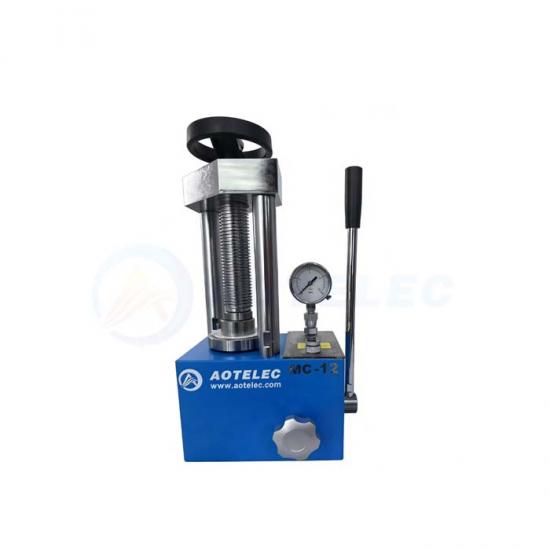
(1) Hydraulic powder presses are currently the most widely used type in mass production lines. Their advantages are evident: a wide tonnage range, from 10 to 1500 tons, making them particularly suitable for high-pressure compaction of large-sized, thick electrode sheets; stable pressure output and excellent pressure holding performance; mature technology and relatively controllable procurement costs. However, traditional hydraulic presses also have drawbacks: pressure accuracy typically ranges from ±1% to 2%, which is inferior to servo models; hydraulic oil carries leakage risks, making them unsuitable for cleanrooms at the 10,000-class level or for handling sensitive materials such as sulfides; the oil pump continues to operate during standby, resulting in higher energy consumption, and oil and filter replacements are required every 2,000 hours, leading to substantial maintenance workload. The new generation of hydraulic presses equipped with upgraded servo proportional valves show significant improvements in precision and energy efficiency, making them the mainstream choice for current mass production lines.
(2) Electric servo powder presses have emerged as the fastest-growing high-end model in recent years. Driven directly by a servo motor and ball screw without any hydraulic system, they completely eliminate oil contamination issues—particularly critical for sulfide solid electrolyte production lines, where even trace amounts of oil can cause electrolyte failure. Servo presses achieve pressure accuracy within ±0.5%, with pressing speeds continuously adjustable from 0.1 mm/s to 50 mm/s, offering exceptional process flexibility. In terms of energy consumption, the servo system delivers power on demand, saving 30%–50% compared to hydraulic presses of the same tonnage, while also requiring significantly less maintenance.
(3) Mechanical powder presses rely on eccentric wheels or crank mechanisms to apply pressure, featuring simple structures and low purchase costs. However, they are rarely used in the battery industry. The reasons are straightforward: poor pressure accuracy, typically ±2%–3%; fixed stroke length, making it impossible to flexibly adjust the pressing curve; numerous lubrication points leading to heavy oil contamination, which fails to meet the cleanliness requirements of lithium batteries. These presses are better suited for large-scale, simple pressing of low-end powder metallurgy parts. For battery electrode sheets, which demand high precision and consistency, mechanical presses are essentially not considered.
4. Frequently Asked Questions
Q1: What causes delamination and powder shedding at the edges of pressed electrodes? There are three main reasons: first, excessive pressing speed prevents air trapped in the powder from escaping in time, causing it to accumulate at the edges and lead to delamination. The solution is to add a pre-pressing and degassing stage, gradually increase pressure, maintain pressure for degassing, and then proceed with final pressing. Second, insufficient surface smoothness of the mold inner wall or too small demolding taper angle can cause friction during demolding, tearing the edges. It is recommended to polish the mold inner wall to a roughness below Ra0.4 and set the taper angle between 0.3°–0.5°. Third, poor powder flowability results in uneven distribution; adding a small amount of PVDF binder through dry mixing can improve this issue.
Q2: Can one machine press different materials? How long does mold change take?
The machine body is universal, but pressing densities vary significantly among different materials (ternary, lithium iron phosphate, graphite, sulfide electrolytes), so dedicated molds are required for each. Manual mold change takes approximately 30–45 minutes, while models equipped with quick-change fixtures can complete the process in under 10 minutes. If material changes are frequent, it's recommended to choose a dual-station or multi-mold library model to prevent cross-contamination. Special note: Sulfide electrolytes react with water to produce highly toxic hydrogen sulfide; used molds must be stored separately and protected with inert gas, and must never be mixed with molds used for oxide materials.
Q3: Can data from a lab-scale press be scaled up to mass production? This is a common challenge when transitioning from R&D to mass production. Small circular electrodes pressed in lab-scale molds typically achieve higher compaction densities than long strip electrodes on large production lines, due to their smaller size and more uniform pressure distribution. Directly applying the same parameters can lead to problems. To ensure scalability, three conditions must be met: consistently using MPa as the pressure unit instead of tons; maintaining identical pressure application and holding curves; and preferably selecting presses with the same structure as those used in mass production (e.g., floating mold bidirectional pressing). When these three conditions are satisfied, parameter deviations during scale-up can be kept within 5%.
From a powder in the lab to an electrode sheet on the production line, the battery powder pressing machine serves as a crucial bridge transforming material performance into battery performance. Choosing the right one makes it a powerful tool for enhancing energy density, ensuring consistency, extending cycle life, and guaranteeing safety; choosing the wrong one, however, could turn it into a quality bottleneck for the entire production line.

Tel/Whatsapp: +8619906035385

Friend link :
AOT BATTERY IPv6 network supported
Scan to wechat: