


-
Call Us
+8619906035385 -
Email us
ping@aotbattery.com
Call Us
+8619906035385Email us
ping@aotbattery.com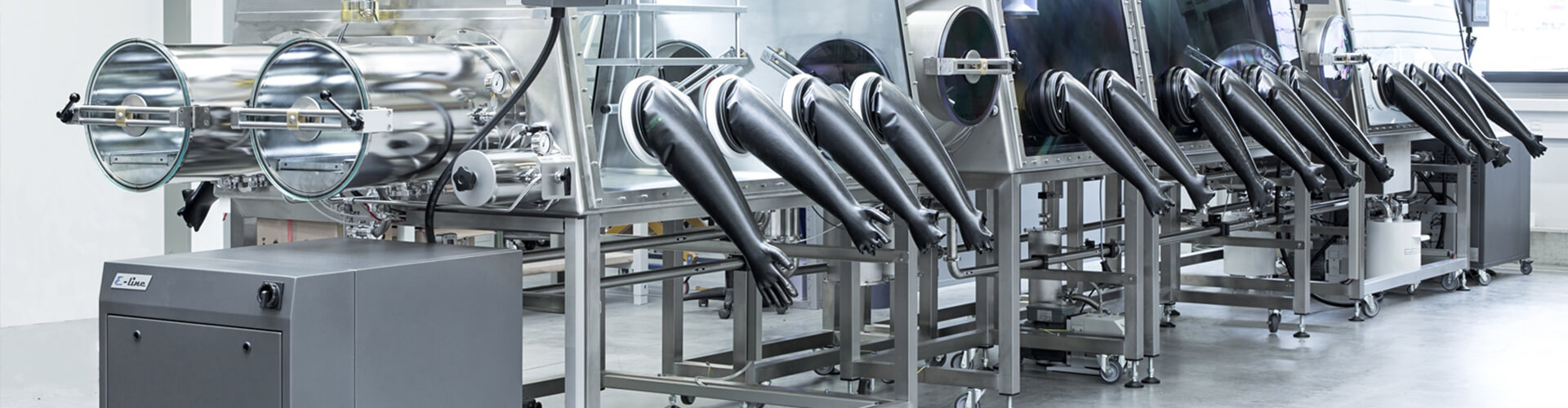
Cylindrical lithium batteries (18650, 21700, 4680 and other models) dominate consumer electronics, power tools and new energy storage markets. The sealing process is an irreversible core manufacturing procedure after electrolyte injection, degassing and cap assembly. A cylindrical battery sealing machine is specialized precision equipment that mechanically crimps and compresses the battery steel shell and top cap to form a fully airtight metal joint. Poor sealing will directly cause electrolyte leakage, internal moisture infiltration, self-discharge acceleration, bulging or even thermal runaway hazards. This article systematically elaborates the core working principle of the machine and standardized safety, operation and maintenance precautions for laboratory and mass production use.
1. Core Working Principle of Cylindrical Battery Sealing Machine
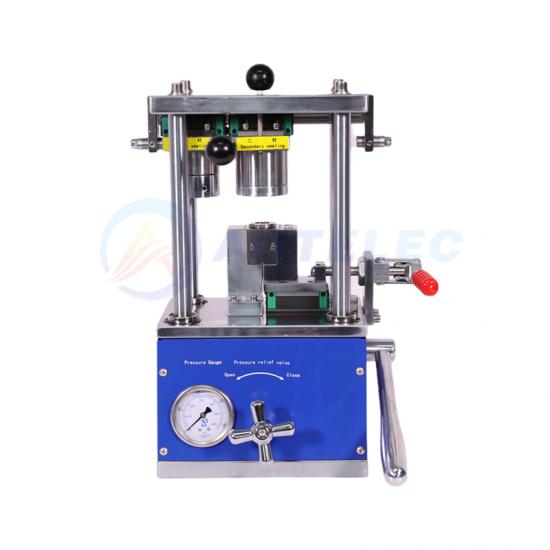
There are three mainstream driving types of sealing equipment: manual hydraulic, semi-automatic pneumatic and fully automatic servo crimping machines, all following the identical cold crimp sealing logic without high-temperature welding. The whole working system consists of a power drive unit, high-precision positioning mold, four-column guide mechanism, pressure monitoring module and safety control system.
1.1 Mechanical Crimp Sealing Mechanism
After liquid injection and standing, the cylindrical cell with a pre-grooved steel shell and assembled cap is fixed vertically into the matched lower positioning mold. The upper sealing die is driven by hydraulic cylinder, air cylinder or servo motor to move downward along parallel linear guide posts, applying uniform vertical pressure on the shell’s curled edge and metal cap gasket. Under calibrated constant pressure, the thin steel rim of the shell is plastically deformed and tightly folded onto the cap’s sealing ring, creating a continuous, gap-free metal sealing edge. This physical cold compression isolates the internal electrode system from external air, moisture and dust, blocking electrolyte volatilization and preventing oxygen inside the cell from triggering side reactions.
Standard pressure range differs by battery size: 6–8 MPa for 18650/21700 cells, equivalent to 1000–1200 kg vertical crimp force. Excessive pressure crumples the steel shell and damages internal pole tabs; insufficient pressure leaves tiny micro-gaps leading to slow leakage after long-term storage. Most industrial machines adopt two-stage crimping: pre-sealing to preliminarily fold the shell edge, then shaping sealing to flatten the crimp line for consistent flatness and air tightness.
1.2 Complete Operation Flow
Preparation: Install size-specific molds, calibrate pressure gauge, connect power/dry air source and conduct 3–5 empty test runs to check smooth die movement.
Loading: Place the capped cylindrical battery vertically into the lower positioning fixture, ensuring zero tilt.
Sealing trigger: For manual models, rotate the hydraulic handle to boost pressure; automatic equipment activates the cylinder after photoelectric detection of the battery.
Pressure holding: Maintain set crimp pressure for 0.5–2 seconds to stabilize plastic deformation of the steel shell.
Pressure relief & unloading: Release hydraulic or air pressure, the upper die automatically rises, then take out the finished sealed cell for air tightness inspection.
1.3 Auxiliary Functional Principle
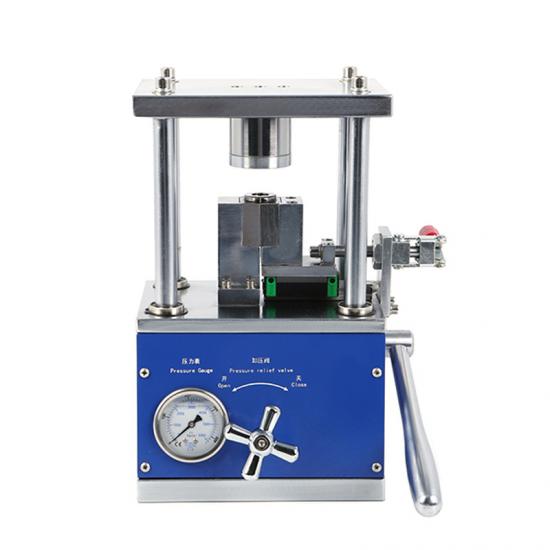
High-precision pressure gauges and digital pressure sensors monitor real-time crimp force to automatically alarm for overpressure or underpressure. Four-column ball guide sleeves guarantee parallel movement of the upper die, eliminating uneven sealing lines caused by tilt. Small lab hydraulic sealing machines are compact and glove-box compatible, while full-automatic production line models add conveyor feeding, cyclic counting and emergency interlock protection to realize continuous batch sealing at 40–55 pieces per minute.
2. Standard Operation & Safety Precautions
2.1 Pre-operation Inspection Rules
First, check the equipment’s grounding wire to avoid static sparks igniting electrolyte vapor. The air source must be dry compressed air (0.5–0.7 MPa) free of water and oil; water vapor inside the cylinder corrodes precision molds. Confirm that the matched mold for the current battery model is locked tightly—loose molds produce offset sealing edges. Operators must wear cut-resistant gloves and safety goggles; long hair must be tied up to prevent entanglement with moving components. Empty test runs are mandatory before formal production to listen for abnormal collision noise of guide posts or dies.
2.2 In-operation Critical Rules
Never insert any part of the hand into the die clamping area during operation, even for sample adjustment. Automatic machines adopt two-hand trigger switches to avoid single-hand accidental startup. Strictly follow process pressure parameters without arbitrary adjustment: overpressure deforms the battery shell and may puncture internal separators, while low pressure causes unqualified sealing. If electrolyte overflows on the mold surface during loading, pause the machine immediately and wipe the mold with anhydrous ethanol after full pressure relief; residual electrolyte corrodes the die’s precision surface and weakens sealing effect. Continuous operation time should not exceed 2 hours consecutively to prevent hydraulic oil overheating or cylinder seal aging.
2.3 Post-operation & Daily Maintenance Precautions
After daily work, fully release system pressure, cut off power and air supply, then wipe the upper/lower dies, guide posts and workbench with lint-free cloth to remove electrolyte residue and metal debris. Lubricate linear guide sleeves with anti-rust light oil every 3 working days to keep lifting movement smooth. All molds are heat-treated alloy steel; never grind or polish the sealing edge by hand, which destroys dimensional accuracy. If the machine will be idle for more than one week, spray anti-rust oil on all metal moving parts and cover the equipment with dustproof cloth. Check fastening screws of molds and guide columns weekly to eliminate loosening that causes unstable crimp quality.
2.4 Special Environment Precautions for Glove Box Use
Many lab sealing machines are placed inside argon-filled glove boxes for moisture-free cell processing. Before putting the machine into the box, fully seal all air pipeline joints with epoxy grease to prevent glove box atmosphere pollution. The compressed air inlet must connect an additional drying filter, and daily check for water accumulation inside the machine’s hydraulic oil tank. Do not open the hydraulic pressure relief valve inside the glove box to avoid mixing outside moist air into the inert environment.
3. Common Fault Avoidance Notes
Unqualified sealing (air leakage) mostly results from mismatched molds, insufficient crimp pressure or dirty mold sealing surfaces; regularly clean the die’s contact area to eliminate foreign matter. Shell deformation is caused by overpressure or tilted battery placement during loading, so strictly standardize vertical positioning. Persistent pressure gauge fluctuation usually comes from aging cylinder sealing rings or leaking hydraulic valves, which require professional replacement by designated maintenance staff. Non-professional technicians are forbidden to disassemble hydraulic cylinders, servo drive modules or internal control circuits to avoid permanent equipment damage and safety accidents.
The cylindrical battery sealing machine relies on cold mechanical plastic deformation to achieve reliable air isolation of battery cells, and its stable performance directly determines battery safety and cycle life. Strict compliance with working parameter standards, safety operation specifications and periodic maintenance rules can reduce defective rates, extend equipment service life and eliminate production safety risks. All operators must receive systematic training before independent operation, and record daily pressure data, maintenance records and defective sealing samples for traceable quality control of lithium cell manufacturing.

Tel/Whatsapp: +8619906035385

Friend link :
AOT BATTERY IPv6 network supported
Scan to wechat: