


-
Call Us
+8619906035385 -
Email us
ping@aotbattery.com
Call Us
+8619906035385Email us
ping@aotbattery.com
Recently, a three-electrode sealed electrolytic cell tailored for full-scenario laboratory electrochemical testing has completed the iteration of its full-size lineup and officially launched on the market. Targeting long-standing industry pain points in research fields including new energy materials, electrocatalysis, corrosion analysis and environmental electrochemical detection—such as poor sealing performance, limited size options, weak system compatibility and narrow temperature tolerance—the device adopts high-stability materials and structures alongside modular opening design and full-volume specifications. It delivers standardized, high-precision and highly reusable electrochemical reaction vessels for university laboratories, R&D centers of new energy enterprises and third-party testing institutions, simultaneously upgrading the precision and versatility of domestically produced electrochemical characterization equipment.
Against the backdrop of advancing the "Dual Carbon" strategy, research demands for lithium-ion batteries, solid electrolytes, water electrolysis for hydrogen production, electroreduction of carbon dioxide and other cutting-edge fields keep surging. As core supporting consumables for electrochemical workstations, electrolytic cells directly determine the reliability of experimental data obtained from cyclic voltammetry, linear sweep voltammetry, potentiostatic electrolysis, Faradaic efficiency measurement and other tests. Traditional open electrolytic cells suffer severe drawbacks such as electrolyte volatilization and side reactions triggered by air infiltration. Conventional simple sealed cells are prone to liquid leakage, poor temperature resistance and fixed openings incompatible with diverse working conditions. Researchers frequently need to switch between electrolytic cells of different sizes and structures, which not only raises experimental costs but also reduces the repeatability of parallel test data due to inconsistent equipment performance, forming a major bottleneck restricting the efficiency of fundamental electrochemical research. The newly launched three-electrode sealed electrolytic cell has undergone systematic optimization across five dimensions: material composition, sealing structure, opening layout, volume gradient and expansion compatibility, providing an all-in-one solution for multi-scenario experimental requirements.
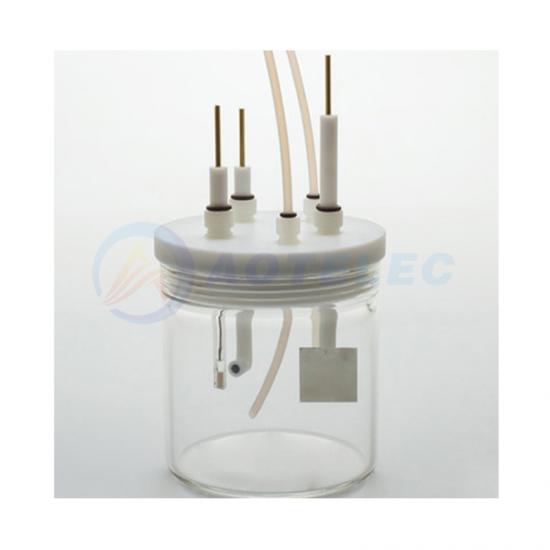
In terms of materials, the electrolytic cell adopts a composite structure of high-boron glass cell body and PTFE (polytetrafluoroethylene) lid, balancing three core merits: visual observation capability, chemical inertness and long-term sealing durability. High-boron glass features an ultra-low coefficient of thermal expansion and excellent thermal shock resistance. Its fully transparent body allows direct observation of reaction phenomena including electrode bubble generation, solution color change and precipitate formation. In addition, it resists most strong acids, strong alkalis and organic electrolyte solvents without ion leaching that would interfere with test results. The integrated PTFE lid boasts supreme chemical inertness and insulation performance, eliminating the risk of short circuits between electrodes. It resists aging and deformation after long-term immersion in corrosive systems, with a service life over three times longer than ordinary plastic lids, greatly cutting the frequency of consumable replacement in laboratories.
The sealing system adopts a dual sealing design combining threaded compression and rubber gaskets, completely eliminating gas leakage and liquid seepage during long-term potentiostatic testing and atmosphere-protected experiments. Traditional snap-on sealing structures bear uneven force, and sealing gaskets tend to loosen after prolonged water bath temperature control. In contrast, the threaded tightening structure enables uniform compression force distribution. Together with built-in rubber rings, it forms multi-layer airtight barriers fully suitable for inert gas purging experiments with nitrogen or argon. It effectively isolates oxygen and carbon dioxide in the air from infiltrating the electrolyte, preventing catalyst deactivation and potential drift. The cell supports continuous electrolysis lasting several days, delivering stable and controllable data for high-precision tests such as trace catalysis and low-concentration corrosion detection.
It features a standardized modular opening layout with a basic configuration of 6 mm three-electrode ports plus two 3 mm gas ports, while fully customizable opening schemes are available to flexibly meet diverse experimental expansion needs. The three standard 6 mm electrode jacks can simultaneously accommodate working, reference and counter electrodes to construct a complete standard three-electrode testing system. This separates the current circuit from the potential detection circuit to eliminate inherent ohmic drop errors in two-electrode systems and accurately capture the kinetic characteristics of electrochemical reactions. The two 3 mm gas ports serve separate functions: purging inert gas to remove dissolved oxygen and exporting reaction products for quantitative analysis of generated gas. The cell is inherently compatible with Luggin capillaries, which bring the reference electrode close to the surface of the working electrode to minimize potential deviation induced by solution resistance. This significantly improves the accuracy of electrochemical impedance spectroscopy and trace electrochemical signal testing, making it ideal for high-precision in-situ characterization experiments.
Its applicable temperature range spans from room temperature to 60 °C, perfectly matching conventional constant-temperature water bath experimental conditions, including aging tests of battery materials, mild-condition electrosynthesis and water quality electrochemical analysis. The glass and PTFE composite materials withstand temperature fluctuations without sealing failure or material dissolution upon heating, removing the need for dedicated high-temperature electrolytic cells and lowering laboratory equipment inventory costs.
A full gradient of standardized volume specifications has been mass-produced, covering nine mature models: 30 mL, 50 mL, 100 mL, 150 mL, 200 mL, 250 mL, 300 mL, 500 mL and 1000 mL. These sizes cover the full workflow from rapid screening of trace catalysts and medium-scale potentiostatic electrolysis to small-batch electrosynthesis product preparation. Small-volume models of 30–150 mL suit fundamental university teaching and high-throughput rapid screening of new materials. Medium-capacity versions of 200–300 mL represent mainstream universal laboratory specifications, balancing testing precision and product collection volume. Large-capacity 500 mL and 1000 mL cells cater to pilot-scale electrochemical reactions and cyclic testing of bulk electrolytes for enterprises. All models share unified standards for structure, openings and threads. Laboratories can switch between different volume tests with one set of electrochemical workstations and electrode accessories without additional fitting, substantially boosting equipment reuse efficiency.
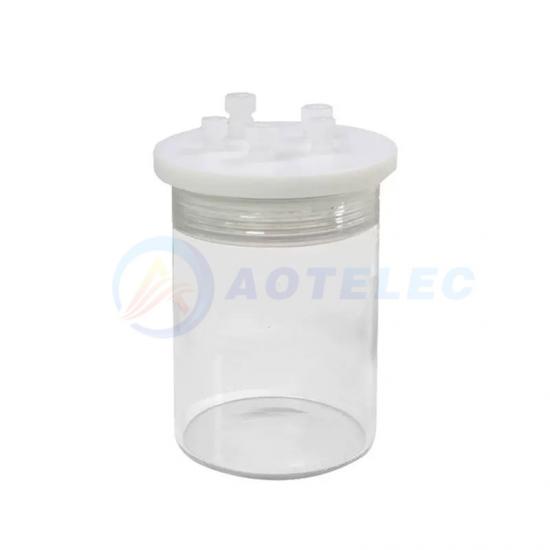
Core design advantages directly address practical pain points for researchers. First, the fully sealed integrated cavity avoids electrolyte volatilization waste and instrument corrosion risks, reducing reagent consumption in experiments. Second, the integrated molded PTFE lid allows easy assembly and disassembly with smooth electrode insertion and removal, enabling one-person rapid setup of experimental devices. Third, native compatibility with gas pipelines and Luggin capillaries eliminates extra modification work for atmosphere-protected high-precision testing systems. Fourth, standardized mass production across all sizes ensures consistent dimensions, apertures and threads, facilitating bulk procurement and unified laboratory management to cut purchasing and training expenses.
The three-electrode sealed electrolytic cell has completed batch field testing in electrochemical laboratories of multiple Double First-Class universities and R&D centers of leading new energy material enterprises. Test feedback from university electrochemical research institutes indicates that when applied to parallel performance testing of CO₂ electroreduction and hydrogen evolution catalysis, the sealed cell delivers no obvious drift on test curves over 72 consecutive hours, with data repeatability improved by more than 40% compared with traditional open cells. New energy battery laboratories adopt the 500 mL large-volume model for long-cycle testing of interfacial stability in solid electrolytes. No liquid leakage or atmosphere escape occurs throughout the test, eliminating the need for manual electrolyte refilling and greatly lowering labor supervision costs.
Industry analysis shows that amid accelerated localization of domestic electrochemical research equipment, market demand for versatile, stable and multi-size standardized electrolytic cells continues to rise. High-end imported three-electrode sealed electrolytic cells have long dominated the market, plagued by long procurement lead times, high unit prices and limited size options. Most domestic alternatives suffer rough sealing craftsmanship, discontinuous volume specifications and weak expansion compatibility. The newly launched three-electrode sealed electrolytic cell balances premium performance and cost-effectiveness via mature mass production technology. All specifications are available in stock, and customized opening requests can be delivered rapidly, filling the market gap in mid-to-high-end general domestically produced sealed electrolytic cells.
Looking ahead, the R&D team will continuously upgrade product technologies, developing derivative versions including high-temperature resistant models, jacketed cells with double-layer water bath temperature control, and two-compartment separated cells with ion diaphragms. Specialized variants will be engineered for unique experimental scenarios such as photoelectrolysis, high-pressure atmosphere environments and electrolytes with strong corrosiveness. Supported by standardized modular design, the team will optimize matching compatibility with mainstream domestic electrochemical workstations and in-situ spectral characterization equipment to build a comprehensive product matrix of electrochemical testing consumables. The product line will continue to provide stable and reliable underlying experimental vessels for researchers engaged in new energy, environmental monitoring, material chemistry, corrosion protection and other fields, supporting high-quality development of fundamental electrochemical research and industrial R&D across China.

Tel/Whatsapp: +8619906035385

Friend link :
AOT BATTERY IPv6 network supported
Scan to wechat: