


-
Call Us
+8619906035385 -
Email us
ping@aotbattery.com
Call Us
+8619906035385Email us
ping@aotbattery.com
1.What is a battery spot welding machine?
A battery spot welding machine is a specialized welding equipment that generates local high temperature by concentrating current in an instant, causing the battery terminals (or tabs) to form a metallurgical bond with the connecting materials (nickel strips, bus bars, etc.). It is widely used in the assembly and production of lithium batteries (cylindrical, square, pouch type). Its core principle is to use the resistance heat generated by the current passing through the contact points to heat the welding area to a molten state. Under the pressure of the electrodes, a strong and stable solder joint is formed without damaging the internal electrolyte and active substances of the battery.
Unlike general spot welding machines, battery spot welding machines must meet the three core requirements of "low heat impact, high precision, and high stability" - because lithium batteries are sensitive to temperature (over 120℃ can lead to electrolyte decomposition), and the terminal materials (copper, aluminum, nickel) have strong conductivity and heat conductivity, the welding must be completed within milliseconds to avoid heat diffusion affecting the battery performance.
The core function of the battery spot welding machine
Realize mechanical connection and conductive path: Through the welding points, the battery cells are fixed with the nickel strips and bus bars, forming the mechanical structure of the battery module / PACK. At the same time, it ensures the low-resistance current conduction between the cells, avoiding the risk of overheating and fire caused by poor contact;
Ensure battery safety and lifespan: High-quality welding points can withstand charging and discharging cycles, high and low temperature environments, vibration and impact, preventing false welding, detachment (causing local high temperature and battery fire), or excessive contact resistance (resulting in range degradation and heat loss);
Improve production efficiency and consistency: The automated battery spot welding machine can achieve high-speed, batch welding (up to 200 points per minute), and through precise control of current, pressure, and time, ensure the consistency of each welding point parameters, reducing the defect rate of the battery module;
Adapt to various battery production scenarios: For different battery types (consumer electronics small batteries, automotive power batteries, energy storage large batteries), and different connection materials (nickel strips, copper strips, aluminum strips, composite strips), provide customized welding solutions to meet diverse production needs.
2.Key Comparison: The Core Dimension for Selecting the Right Battery Spot Welding Machine
|
Type of technology |
Core Advantage |
Applicable scenarios |
Key weakness |
|
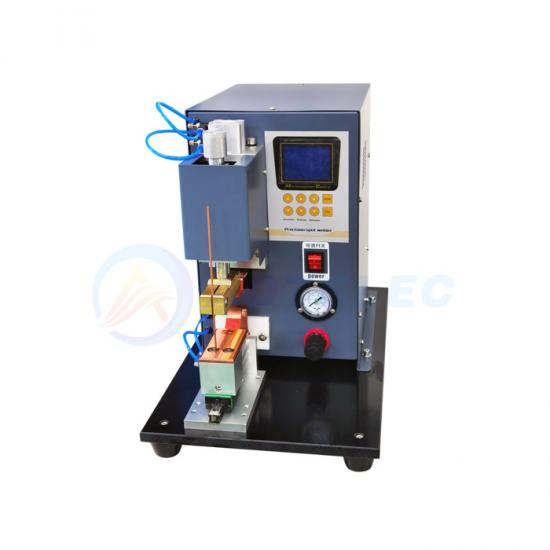
Resistance Spot Welding Machine (RSW) |
Low cost, fast speed (100-200 points per minute), strong compatibility |
Batch production of consumer electronics and energy storage battery modules |
The heat-affected zone is relatively large (0.8 - 1.5 mm) |
|
Laser Spot Welding Machine (LSW) |
Small heat-affected zone (≤0.3mm), high precision, no electrode loss |
High-end consumer electronics, precision power batteries |
High equipment costs and difficult maintenance. |
|
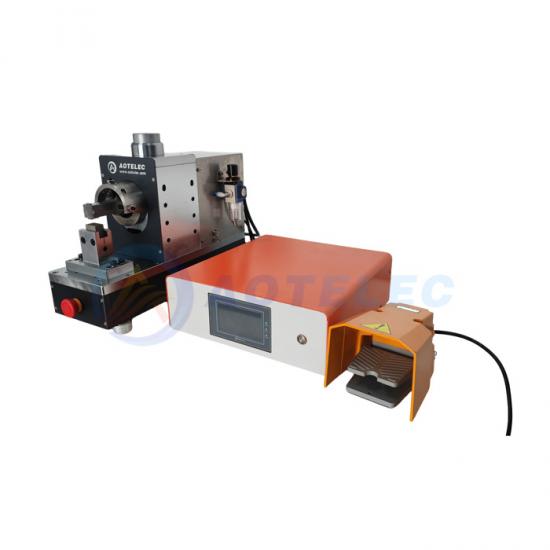
Ultrasonic spot welding machine (USW) |
No heat input, suitable for welding of different materials |
Welding of copper-aluminum composite busbar |
The welding strength is limited and it is not suitable for thick materials. |
3. Frequently Asked Questions
(1) Why do the solder joints of the battery spot welding machine tend to come off or be poorly connected?
The main reasons are: ① The current control accuracy is insufficient (fluctuation exceeds ±1%), resulting in insufficient penetration depth; ② The electrode pressure is unstable and is not adjusted adaptively according to the material thickness; ③ The electrode tip is severely worn (common in resistance spot welding machines), and it is not promptly ground and replaced; ④ The welding surface has an oxide layer or oil stains, and no pre-treatment is done.
Solution: Select a medium-frequency inverter spot welding machine that supports closed-loop control (current accuracy ±0.5%), and equip an adaptive pressure regulation system; regularly clean the electrode tip (it is recommended to check once every 1000 welds); wipe the terminals and the surface of the connecting materials with alcohol before welding.
(2)What are the differences between the spot welding machines for consumer electronic batteries and power batteries?
Consumer electronic batteries (such as 18650, 21700 small cylinders): Focus on "high precision, low thermal impact", and mostly use laser spot welding machines or micro-resistance spot welding machines. The welding current is ≤ 10KA, and the heat affected zone is ≤ 0.5mm, to avoid damaging the battery packaging.
Power batteries (such as square lithium iron phosphate, 4680 large cylinders): Focus on "high current, high speed, high stability", and mostly use medium-frequency inverter resistance spot welding machines. The welding current is 15-50KA, the welding speed is ≥ 100 points/minute, and it needs to support multi-station linkage and modular production.
(3) What is the energy consumption of the battery spot welding machine? Are there energy-saving models available?
Traditional AC spot welding machine: The energy consumption per 1000 spots during a single welding session is approximately 0.8 - 1.2 kWh, and the standby power consumption is ≥ 50W.
Energy-saving medium-frequency inverter spot welding machine: The energy consumption per 1000 spots during a single welding session is as low as 0.3 - 0.5 kWh, and the standby power consumption is ≤ 10W. Annual electricity savings can reach over 30% (calculated based on an annual production of 10 million spots). (Assuming an annual electricity bill of 10 million kWh.)
Recommendation: Prefer to choose equipment with energy-saving motors and intelligent sleep function, and ensure that the power factor of the equipment is ≥ 0.95 (high-quality equipment ≥ 0.95). This can reduce power grid losses.
(4) Which is more suitable for welding copper-aluminum composite busbars, ultrasonic welding machine or resistance welding machine?
Recommended ultrasonic welding machine: The melting points of copper and aluminum differ significantly (copper 1083℃, aluminum 660℃). Resistance welding is prone to "excessive melting of aluminum and insufficient melting of copper", resulting in insufficient weld strength. Ultrasonic welding machine achieves solid-phase welding through mechanical vibration, without heat input, which can avoid material oxidation and defects caused by the difference in melting points. The tensile strength of the weld point is ≥120N, meeting the requirements for large current transmission of the busbar.
4. Selection Suggestions: Quickly match the optimal solution based on requirements
If it is a consumer electronics battery assembly factory (for mobile phones, power banks, notebook batteries): If the budget is sufficient, choose a laser spot welding machine (with minimal heat impact and high precision); if the budget is limited, choose a micro medium-frequency resistance spot welding machine (with low cost and strong compatibility);
If it involves the welding of copper-aluminum composite busbars (for energy storage batteries and high-end power batteries): The ultrasonic spot welding machine must be selected to avoid the welding defects caused by resistance spot welding;
For small-scale customized production (laboratories, small-scale manufacturing plants): Choose a portable spot welding machine, which supports manual parameter adjustment, has a small size, is easy to operate, and has a low single-welding cost.

Tel/Whatsapp: +8619906035385

Friend link :
AOT BATTERY IPv6 network supported
Scan to wechat: