


-
Call Us
+8619906035385 -
Email us
ping@aotbattery.com
Call Us
+8619906035385Email us
ping@aotbattery.com
In the R&D chain of lithiumion batteries, greater attention is often paid to material formulation, electrode coating and electrolyte matching. The winding process that assembles electrodes and separators, however, has long been treated as a trivial downstream procedure. Many cell development teams have noticed inconsistent test results even with identical raw materials and formulations. Variations in core tightness, misaligned finishing layers and unstable tension frequently distort experimental data rather than stem from material defects.
Manual winding remains common for small batch laboratory prototyping. Operators rely heavily on personal experience to control core compactness, count winding turns by visual inspection and align finishing sections through intuition. This approach works for limited samples of a single specification. Once multiple cell formats and iterative tests are underway, sample consistency deteriorates drastically. Even cells produced from the same formula may deliver divergent internal resistance and cycling performance. Researchers end up spending excessive time eliminating process induced noise instead of advancing material innovation.
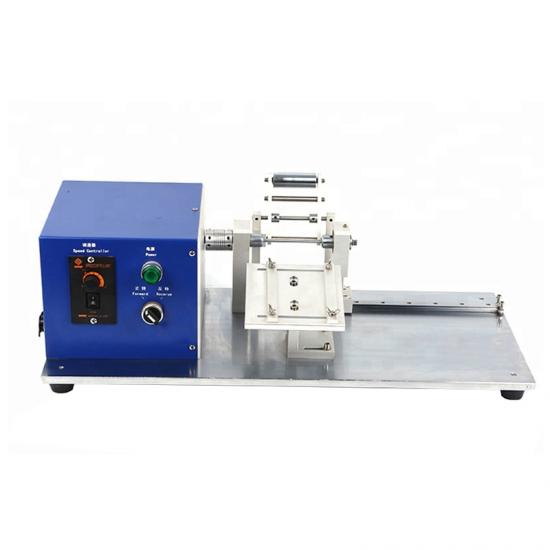
Transforming winding from experience dependent manual work into parameter driven repeatable operations has become critical for reliable battery research. Modern benchtop winding platforms feature multi directional adjustable feeding channels. Instead of swapping dedicated guide grooves for every new cell size, operators can fine tune electrode alignment, gaps and feeding angles vertically, horizontally and depth wise. Format conversion can be completed within minutes, bringing notable convenience for laboratories frequently testing cylindrical cell variants.
Core compactness and finishing precision receive dedicated mechanical optimisation. Support wheels maintain consistent compression during winding and prevent loose layers between electrodes and separators. A dedicated end winding supporter addresses offset defects at the final rotation, effectively reducing oval shaped cores and layer misalignment — two persistent pain points of manual winding.
Winding speed supports stepless adjustment together with selectable clockwise and counter clockwise rotation. Researchers can lower rotation speed for tension focused trials or raise speed for higher volume sample preparation. Designed for global laboratory environments, the unit accepts 110 V / 220 V AC power input at 50 / 60 Hz with low power consumption. Depending on cell dimensions and operator proficiency, it can produce 70-100 wound cores per hour, fully meeting sample demands spanning lab scale trials to prepilot validation. Fixed speed settings also ensure uniform processing conditions across one batch of samples and eliminate human introduced variables
Compact physical dimensions expand application flexibility. With a small footprint and net weight of roughly 20 kilograms, the platform fits neatly onto standard laboratory benches without occupying excessive workspace. It can be deployed at material evaluation laboratories, university research groups and in house cell development centres. Interchangeable winding shafts support classic cylindrical formats, custom sized mandrels on request, and alternative square shafts for pouch cell core fabrication. Matching winding accessories are configured according to targeted cell models, removing the need for costly custom rework for each new product under development.
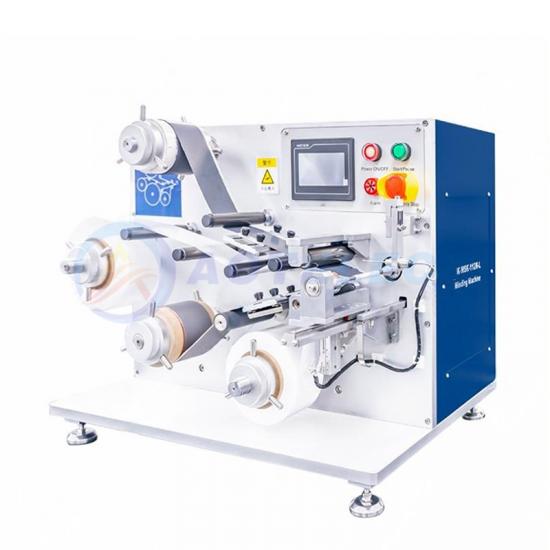
The hidden costs of manual laboratory winding mostly lie in high rework rates. Poor sample consistency confounds failure analysis, making it hard to distinguish material related defects from process errors. Formulation validation often requires repeated rounds of remanufacturing. By stabilising winding parameters, process related fluctuations are minimised and genuine material performance differences can be accurately observed.
For material suppliers, stable in house sample preparation generates more trustworthy presubmission test data. For cell manufacturers, multi specification parallel development no longer faces equipment bottlenecks. For universities and testing institutions, reproducible small batch sample manufacturing no longer depends on highly skilled technicians. What these scenarios require is not massive production capacity, but reliable repeatability for every single sample.
As emerging battery chemistries including sodiumion and semi solid systems move into verification phases, R&D teams demand faster, more reproducible and multi-format sample making capabilities. Standardised laboratory level winding represents more than hardware upgrades. It decouples critical process variables from subjective human judgement and converts them into traceable, replicable parameters. For battery researchers, every experiment free from process caused errors brings valuable progress for material iteration.
FAQ
Q1:How long do you need to prepare my goods?
A: 3-5 days for battery materials. 5-25 days for equipment (based on different model and quantities).
Q2:Can we have our logo or company name to be printed on products or package?
A: Sure. your logo could be printed on your products by hot stamping, printing, embossing, UV coating, silk-screen printing or sticker. In order to explore the market better and provide more convenient services to global customers, we sincerely invite overseas agent to create bright future together.
Q3:How can I install and operate the machine by myself?
A: Our system R&D based on integrated development view. when you get the machine, just need to connect it with the electrical power, then machine can be working. because the English software were installed in this machine. what you need to do is only learning the software usage, and the complete English user manual will be coning to you with the machine.
Q4:How to get technical support after purchasing?
A: Our factory provide online technical support in English , you can easy catch us online by Skype, Wechat, and Email, if you need any remote assistant support, then we will support you though Team Viewer.

Tel/Whatsapp: +8619906035385

Friend link :
AOT BATTERY IPv6 network supported
Scan to wechat: