


-
Call Us
+8619906035385 -
Email us
ping@aotbattery.com
Call Us
+8619906035385Email us
ping@aotbattery.com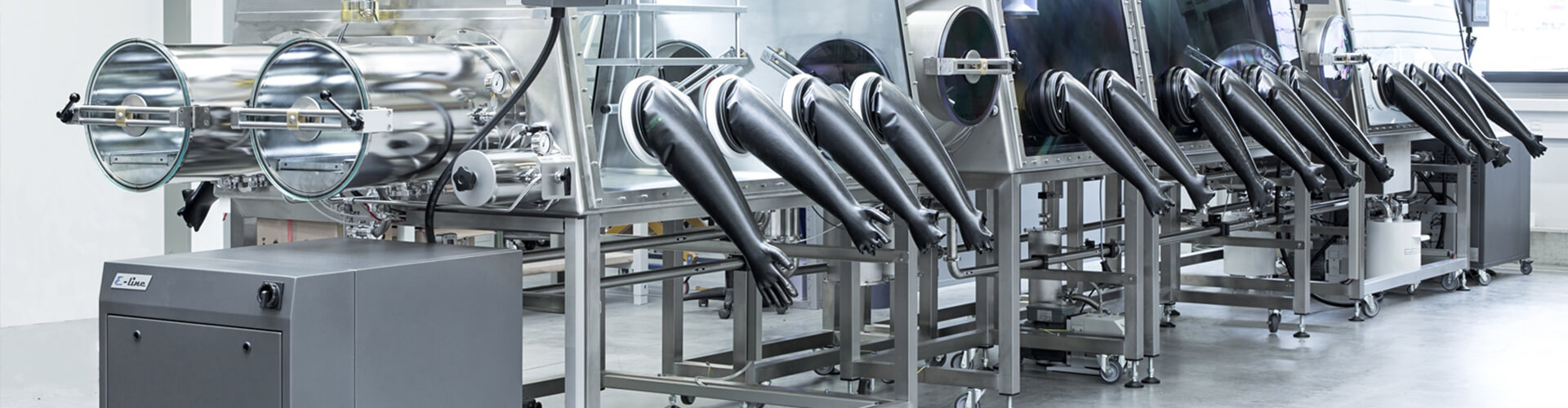
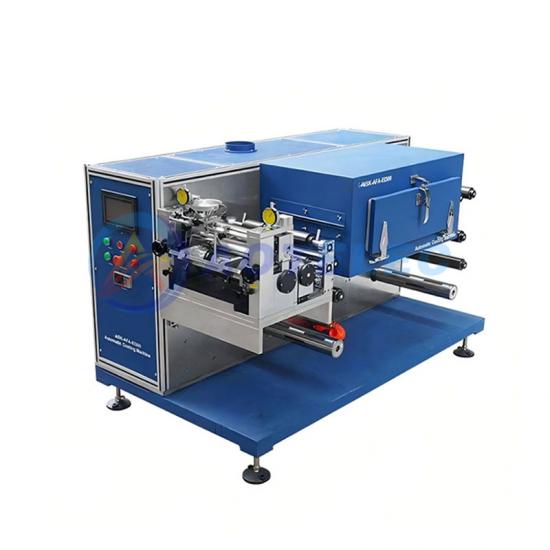
The battery coating machine is a core precision equipment in the manufacturing process of lithium-ion batteries, mainly used for evenly coating the positive and negative electrode pastes on the copper foil and aluminum foil substrates. The coating quality directly determines the energy density, cycle life, product consistency, and safety performance of the battery, and is a key process equipment connecting battery material research and large-scale production. Different from ordinary industrial coating equipment, professional battery coating machines need to be adapted to the characteristics of high-viscosity pastes for new energy, achieving micron-level precision control, and can operate stably under high-temperature and continuous production conditions. It is an indispensable core equipment in the new energy battery production line.
The core function of the battery coating machine
In the entire production process of lithium-ion batteries, coating is the "heart process" that determines the quality of the battery. The battery coating machine, as the core main equipment, plays a key role in the formation of the electrode sheet, performance determination, and quality control, directly affecting the yield and performance of all subsequent production stages of the battery. It is an indispensable key equipment in the mass production of lithium-ion batteries.
Firstly, the equipment achieves uniform and precise coating of the positive and negative electrode pastes, laying the foundation for the basic performance of the battery. It can evenly attach pastes of different viscosities on the surface of copper foil and aluminum foil substrates, precisely control the coating thickness, width, and surface density, ensuring that the loading quantity of each electrode sheet is uniform and consistent. It eliminates problems such as uneven thickness, exposed foil, and accumulation of materials caused by manual or simple equipment coating, locking the rated capacity, discharge efficiency, and charge-discharge stability of the battery from the source, and avoiding the overall performance degradation of the module caused by excessive capacity differences in individual batteries.
Secondly, standardized coating operations significantly enhance the safety performance of batteries. In high-demand production scenarios such as power batteries and energy storage batteries, uneven coating can easily lead to local overheating, imbalance in internal resistance, bulging, and even thermal runaway of the battery. The battery coating machine ensures the dense and uniform coating of the electrode sheet through intelligent tension control, constant temperature feeding, and precise die head discharging, allowing the battery to maintain a balanced temperature and stable internal resistance during high-speed charging and discharging, as well as high-temperature and low-temperature cycling. This effectively reduces the safety risks of the battery and significantly extends its cycle life.
Finally, the entire process of equipment adaptation for production is carried out, reducing costs and increasing efficiency, and ensuring the stability of mass production. From small-scale prototype development, pilot process verification to large-scale mass production, the battery coating machine can adapt to the production requirements of different specifications and materials by adjusting parameters, and is compatible with mainstream pastes such as ternary, lithium iron phosphate, and silicon-carbon. The equipment has a high degree of automation and a low failure rate, and can operate continuously and stably for a long time, significantly reducing manual intervention, downtime maintenance, and defective product losses, effectively reducing the production costs of enterprises, while ensuring the high consistency of batch products, and helping battery factories achieve standardized, intelligent, and large-scale production.
Actual application scenarios of battery coating machines
The performance advantages of battery coating machines can be fully demonstrated in differentiated production scenarios such as laboratory research and development, pilot-scale expansion, and large-scale mass production. All performance manifestations are supported by measured data, and there is no ambiguous performance description.
In the laboratory research scenario of new battery materials, small bench-top battery coating machines need to adapt to the requirements of frequent formula switching and small-batch trial production. When testing 2000-12000 Cps high-viscosity ternary pastes and silicon-carbon negative electrode pastes, the machine can maintain a stable coating speed of 0.1-1m/min, with a dry film coating thickness control range of 6-50μm, and the coating width adjustable range is 50-320mm. After 48 hours of intermittent trial production and repeated start-stop tests, the coating thickness error is still stably controlled within ±2μm, fully meeting the high-precision production requirements for new material formula verification and small-batch sample production.
In the pilot production scenario of battery power, the medium-sized roll-to-roll coating machine undertakes the core task of process verification before mass production. For continuous coating conditions of 300-1600mm wide electrode sheets, the equipment operates continuously for 72 hours in a production environment at 25℃ constant temperature and 55% constant humidity, with a surface density uniformity accuracy of ≤±1.0%. It can complete continuous coating operations for positive and negative electrode sheets of cylindrical, square, and pouch batteries, ensuring the uniformity and consistency of the coating thickness and uniformity of each batch of electrode sheets, providing reliable process parameter basis for subsequent large-scale mass production lines.
Comparison analysis: Differences between high-quality battery coating machines and ordinary coating machines
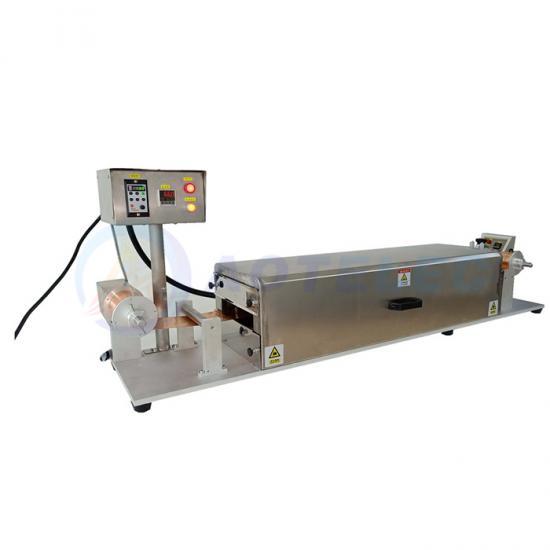
When customers purchase battery coating equipment, they will conduct multi-dimensional product comparisons. The following presents an objective comparison from core parameters and actual usage effects to help customers quickly identify high-quality equipment and avoid selection mistakes.
In terms of precision control, ordinary coating machines mostly use traditional scraper adjustment methods, with the density accuracy ranging from ±2.0% to ±3.0%. After long-term operation, the equipment will experience mechanical wear, and the precision error will continue to increase, easily causing uneven coating of the electrode sheet, ultimately resulting in batch quality differences in battery products. However, high-quality professional battery coating machines adopt slit extrusion coating technology + intelligent tension control system, support real-time precision calibration, and the overall line density accuracy is stably controlled within ±1.0%, with no precision decline during long-term operation, completely solving the problem of batch differentiation of electrode sheets.
In terms of stability and failure rate, ordinary coating machines have limited adaptability to different types of pastes. When dealing with silicon-carbon negative electrode pastes with high solid content and high viscosity, they are prone to problems such as mold head blockage, tape breakage, and coating scratches. During mass production, they need to be shut down for cleaning and maintenance every 3-5 days, seriously hindering production efficiency. High-quality industrial-grade battery coating machines are equipped with independent temperature-controlled paste supply systems and automatic mold head cleaning devices, which are compatible with all types of lithium battery positive and

Tel/Whatsapp: +8619906035385

Friend link :
AOT BATTERY IPv6 network supported
Scan to wechat: